
Stamp formats: sheets, blocks, booklets, se-tenant
A stamp is not always a single stamp. The same design was issued as sheets, blocks, miniature sheets, booklet panes and coils, and each format is catalogued and collected as its own object. Recognising the format matters for the simplest of reasons: an intact block or pane cannot be reconstructed once it is cut apart, and cutting is exactly what most people do first.
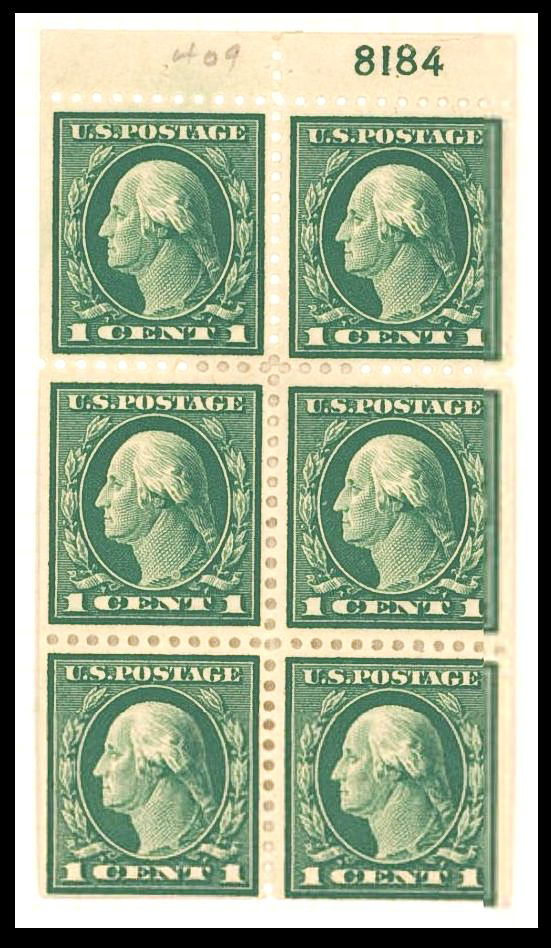
The formats
- Single. One stamp, separated from whatever it came from. The default and the least informative state.
- Block. Four or more stamps still joined, usually two by two. A block shows the relationship between adjacent positions, which is how plate flaws get located.
- Miniature or souvenir sheet. A small sheet issued as a unit, with a decorative margin around one or a few stamps. Cutting the margin off turns a distinct catalogue entry into an ordinary single.
- Booklet pane. A small block sold inside a card cover, usually with one or two straight edges where it was cut, and often a printed tab or selvedge.
- Coil. Stamps from a roll, with two opposite straight edges and sometimes a number printed on the back.
- Se-tenant. Two or more different designs printed joined together. Separated, the whole point is lost – the connection was the issue.
How to recognise a format from a single stamp
- Straight edges. One or two unperforated sides usually mean a booklet or coil rather than a sheet stamp – unless the stamp came from a sheet margin.
- Selvedge. Attached paper margin, sometimes with printer marks, colour bars or a plate number, tells you the position in the sheet.
- Perforation on all four sides with no margin means an ordinary sheet stamp separated normally – which is what most stamps are, as measured in the guide to perforation.
- Gum and paper on the back can differ between booklet and sheet printings of the same design.
Why not to break them up
An intact format is evidence. A block shows which flaw sits next to which; a pane shows how the booklet was made; a se-tenant strip shows an issue that was designed to be read across. Separating them yields ordinary singles that are worth less than the sum and can never be put back – the same one-way logic as removing a stamp from its cover in the guide to postal history. If a format needs to fit an album, the album page is wrong, not the item, as set out in the guide to arranging an album.
Storage notes
- Sheets and panes go flat, never folded – a fold through a stamp is permanent.
- Use mounts or sleeves sized to the whole format rather than to a single stamp.
- Keep booklet covers with their panes; the cover carries the printing data.
- Never hinge an intact sheet, for the reasons in the guide to hinges and mounts.
How common the formats are
In the open archive of 80,472 stamp images from 271 countries and territories, the recorded formats give a sense of proportion: 961 miniature sheets, 91 souvenir sheets, 121 se-tenant items and 61 booklet entries. Everything else is the ordinary sheet stamp – which is why an intact block or pane stands out immediately in a mixed lot, and why it is worth checking before reaching for scissors.
Open the catalogue: world stamps, Soviet stamps.
Quick answers
What is a miniature sheet?
A small sheet issued as a unit with a decorative margin – a catalogue entry of its own.
What do straight edges mean?
Usually a booklet or coil stamp, or a stamp from the margin of a sheet.
Should I separate a block?
No. An intact block cannot be reassembled and is worth more than the singles.
What is se-tenant?
Different designs printed joined together; separating them removes the point of the issue.